
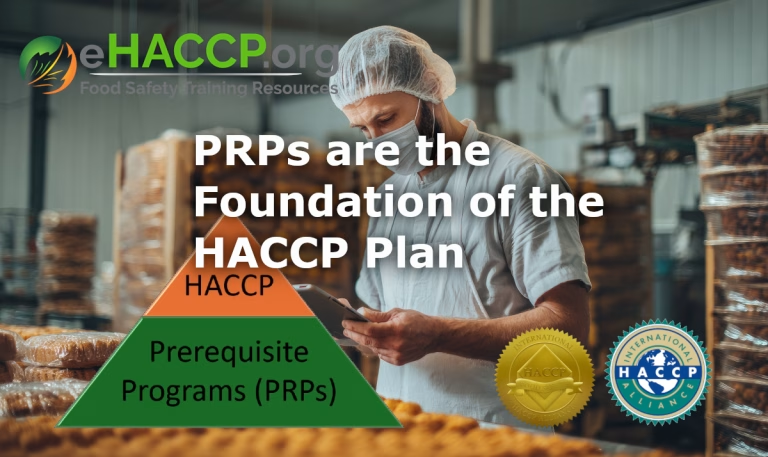
HACCP often gets the spotlight, but PRPs (Prerequisite Programs) are the foundation on which the entire system sits. PRPs are not part of the 7 principles of HACCP; rather, they are the essential, pre-existing conditions that create a safe, hygienic environment to prevent contamination.
People often overlook the importance of PRPs in HACCP. Most courses emphasise HACCP and highlight the 7 principles (hazard analysis, CCPs, critical limits, etc.). PRPs sit outside those principles, so people assume they’re secondary even though they’re foundational. If they are treated as an afterthought, the HACCP plan will be weak or ineffective.
If PRPs are weak, missing, confusing, etc. HACCP becomes complicated, ineffective, and hard to defend during inspections or audits. In a well-built food safety system, about 70–90% of the HACCP system consists of PRPs, and only about 10-30% is the actual HACCP plan, i.e., hazard analysis, CCPs, limits, corrective actions, monitoring, and verification.
Prerequisite Programs (PRPs) are the basic conditions and activities that create a hygienic environment before HACCP controls are applied.
They include programs such as:
- Sanitation
- Personal hygiene
- Allergen control
- Supplier approval
- Pest control
- Equipment maintenance
- Training
- Water quality
- Traceability and recall
- Facility design and zoning
PRPs control the general, everyday hazards in a facility, so HACCP can focus only on the process-specific, high-risk hazards. PRPs Are the Foundation of HACCP
Think of HACCP as a building: the PRPs are the foundation, and HACCP is the framework. If the foundation is weak, the building doesn’t stand. Without solid PRPs Too many hazards end up in HACCP. CCPs become unrealistic, monitoring becomes excessive, the system becomes confusing for staff, and audits become harder to pass. Good PRPs help keep HACCP simple and focused.
PRPs control hazards such as:
- Cross-contamination
- Poor hygiene
- Dirty equipment
- Allergen mix-ups
- Pest activity
- Chemical misuse
- Unsafe suppliers
These are not process steps; they are environmental and operational controls. So instead of controlling handwashing at a CCP, you control it through a Hygiene PRP. Instead of controlling sanitation inside HACCP, you control it through a Sanitation PRP.
If PRPs are vague, HACCP collapses. PRPs must answer four things clearly:
- What is done
- Who does it
- How often is it done
- How it’s verified and recorded
A weak PRP reads like this: Equipment is cleaned regularly.
A strong PRP reads like this: Mixers and tables are cleaned and sanitized at the end of each production day using approved food-grade sanitizer at 200 ppm. The sanitation supervisor verifies completion daily and signs the sanitation log.
If PRPs are incomplete, unclear, or missing hazards can move into HACCP unnecessarily CCPs multiply and overly confusing the plan, staff won’t know what to do, the inspectors see gaps, there will be risk of contamination increases and fundamentally recalls become more likely. In short, you can’t fix a weak system with CCPs. PRPs reduce risk before HACCP starts. PRPs prevent hazards from entering the process in the first place. HACCP then controls the remaining hazards.
eHACCP.org goes beyond HACCP training by covering the Prerequisite Programs (PRPs) that underpin a successful HACCP system. The platform provides more than 250 editable PRP documents to help food businesses efficiently build, customize, and maintain a compliant HACCP plan.
